
While Maturing Options are more associated with finance than with risk management, they offer a right to decide. For finance professionals a maturing option provides a right to decide in the future on whether to exercise the option, sell the option, or let it lapse, depending on its value at maturation date. A mature risk framework drives good risk-informed decision-making, which also means a right to decide: To decide to take a risk or not, or to take some other action, like delaying the decision or modifying circumstances to improve the likelihood of certain outcomes.
Why then do some risk maturity models suggest an organisation can choose their level of maturity to target? Either you are mature and your leaders are confident in making decisions under uncertainty, or you are not. Yes, the Department of Defence will need to go about it differently to the Australian Ballet as I pointed out in my last blog, however, the end result needs to be the same.
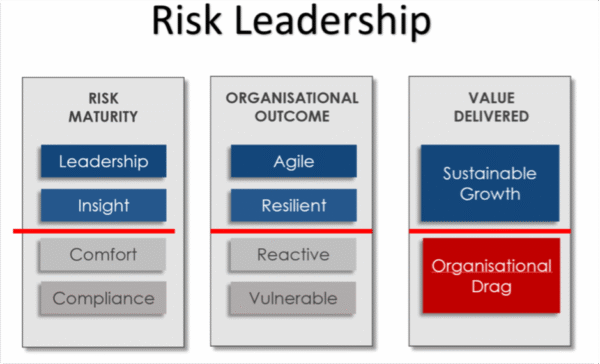
There is only one choice: be at the top of your preferred risk maturity model. Better still, be at the top of mine (below) because then you’ll have a more agile organisation driven by your risk management program, not in spite of it!